
MICE & Economics | Industry Insights
Trade Fairs and Export Promotion: How Exhibitions Open New Markets for African Manufacturers
A factory floor is not a market. The distance between the two is where exhibitions do their quiet economic work.
2026 Export Promotion Trade Fairs Africa
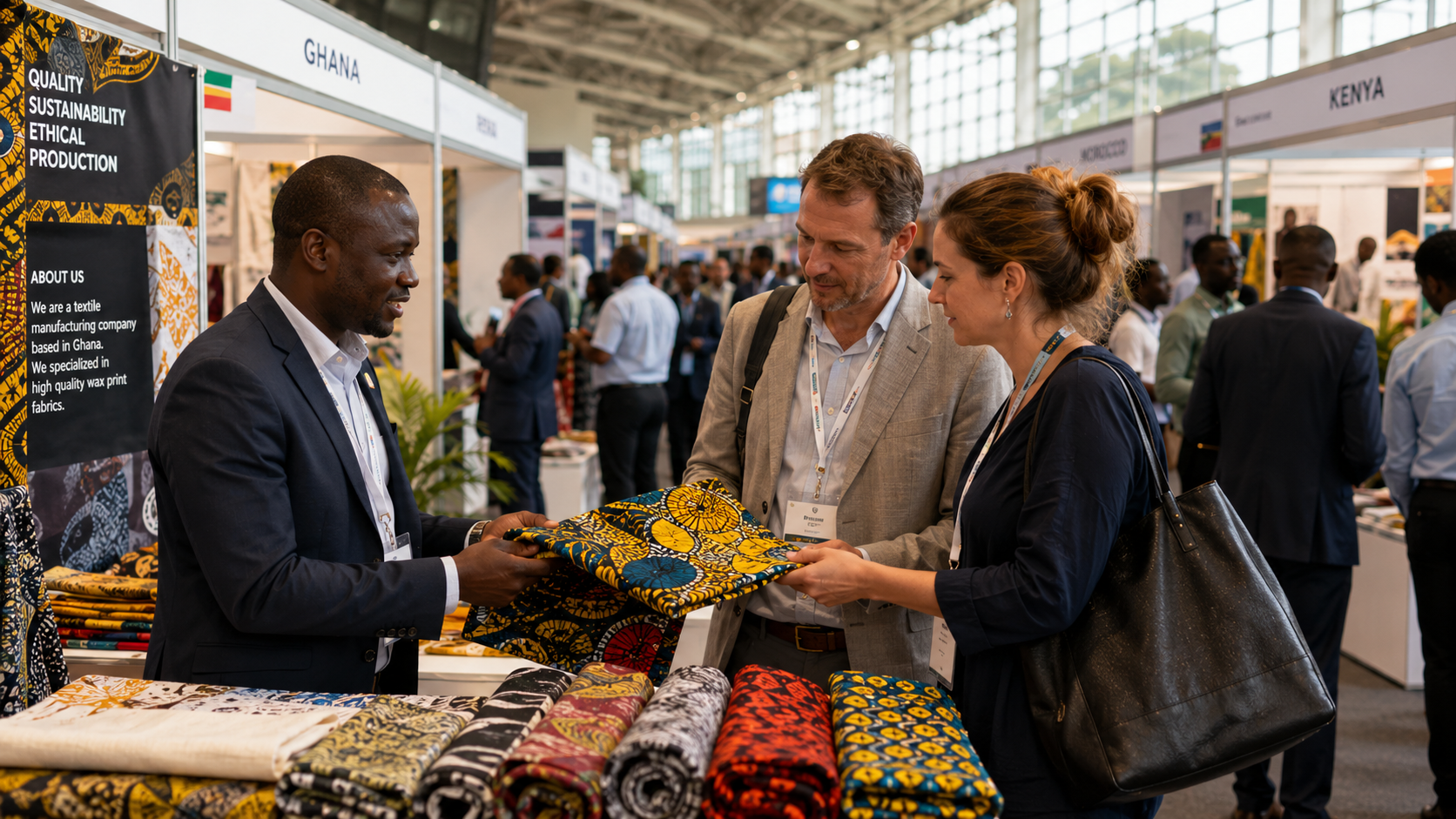
International convention and exhibition center

Exhibition floors compress months of market discovery into a few days under one roof.
Manufacturers in Kenya and across the region often make goods that could compete internationally, but never find the buyer who would prove it. Trade fairs exist to close that specific gap — and the economics behind why they work is more precise than "networking."
The Real Barrier Isn't Production, It's Information
Classical trade theory assumes a manufacturer who can produce competitively will naturally find export markets. In practice, that assumption breaks down long before price ever matters. A manufacturer doesn't know which foreign buyers exist, what standards they require, what they're willing to pay, or whether the relationship is worth the risk of a first shipment. Economists call this an information asymmetry — one of the largest hidden costs in international trade, especially for small and mid-sized African exporters who don't have an overseas sales office to absorb it.
A trade fair compresses that discovery process. Instead of a manufacturer spending months and significant capital trying to identify buyers market by market, a single exhibition puts dozens of qualified buyers, distributors, and regulators in one physical space, over a few days.
Garment factory production floor

Production capability alone rarely finds its buyer — someone still has to build the bridge.
The fair doesn't sell the product. It removes the excuse buyers have for not knowing it exists.
Exhibitions Lower the Fixed Cost of Entering a Market
Every export relationship carries a fixed cost before the first unit is even shipped: market research, compliance checks, relationship-building, sample logistics, and trust. For a large multinational, that fixed cost is a rounding error. For a manufacturer in Nairobi or Kampala trying to reach a new country, it can be the entire reason they never attempt it.
A well-run exhibition effectively pools that fixed cost across every exhibitor and every buyer in the room. The organizer absorbs the cost of assembling the market — venue, buyer outreach, logistics, regulatory liaison — so each individual manufacturer only has to show up and be good at what they do. This is the same logic that makes shared infrastructure valuable anywhere: nobody builds their own road, everyone uses the one that's already there.
Trust Is the Actual Product Being Exchanged
International buyers rarely commit to a first order on price and spec sheets alone. They commit once they've stood in front of the product, spoken to the people behind it, and satisfied themselves the relationship won't fall apart six months in. That's not sentiment — it's risk management on the buyer's side, and it's rational.
This is where exhibitions do work that no catalogue, website, or cold email can replace. Face-to-face contact compresses a trust-building process that might otherwise take a year of correspondence into a single conversation. For manufacturers trying to break into markets where they have no existing reputation, that compression is often the difference between an export deal happening this year or not happening at all.
Two business people shaking hands over a deal

Trust compressed into a conversation — the thing a catalogue can't do.
Why This Matters at a Policy Level, Not Just a Company Level
When export promotion is discussed nationally or regionally, the conversation tends to focus on trade agreements, tariffs, and logistics corridors — all real and important. But market access is also a function of whether manufacturers can physically get in front of the buyers those agreements are meant to benefit. A trade agreement that opens a market on paper still requires someone to walk through the door.
This is the argument for treating exhibition infrastructure — venues, organizing capacity, buyer networks — as part of a country's export promotion toolkit, alongside more familiar instruments like export credit or trade missions. A well-organized international exhibition is a market-access instrument in the same family as a trade delegation, just running on a different mechanism.
What This Looks Like in Practice
EEO's Role: Building the Bridge, Not Just the Stand
This is the thinking behind EEO's role connecting African exhibitors to international platforms. Serving as an official marketing agent for exhibitions abroad is, in effect, doing the fixed-cost-pooling work described above on behalf of manufacturers who would otherwise have to build that market access alone — identifying the right international exhibition, handling the logistics and liaison, and getting African manufacturers into rooms with buyers they would not otherwise reach.
The value isn't the stand space. It's the market access that the stand space is a physical proxy for.
Ready to Put Your Product in Front of the Right Buyers?
EEO works with manufacturers and exhibitors across Kenya and the region to secure participation in international trade exhibitions — handling the logistics so you can focus on the conversation that matters.
EEO
Exhibition & Events Organizers Limited Communication, Event Management & Expomarketing · Karen, Nairobi, Kenya
This piece discusses the economic logic of trade fairs conceptually. It doesn't cite specific market-size, GDP, or export-value figures — we'd rather point you to a verified primary source (e.g. UNCTAD, ITC, or AfCFTA data) than publish a number we can't stand behind. Images sourced from Wikimedia Commons under free licenses.