
MICE insights from EEO
How Exhibitions Create Jobs
Direct, indirect and induced employment across the MICE value chain
An exhibition may last three days, but the work behind it starts months earlier and reaches far beyond the hall. Someone designs the stand, someone prints the banners, someone collects delegates from the airport and someone cooks lunch for hundreds of visitors. Each of them earns an income because the event exists. This article looks at how economists count that work, and why it matters for a city like Nairobi.
Three ways to count a job
When economists measure what an event does for employment, they usually separate the effect into three layers. UFI, the global association of the exhibition industry, uses this same split in its economic impact research with Oxford Economics.
Direct jobs belong to the people involved in planning and producing the exhibition, along with the work that serves exhibitors and visitors as they travel to it. Think of organizers, venue teams, stand builders, security officers and hotel staff.
Indirect jobs sit in the supply chain. A venue buys energy and food ingredients, and it hires specialists for marketing, cleaning, equipment upkeep, technology support, accounting and legal work. The people who supply those goods and services are employed because the event exists.
Induced jobs appear when all of those workers spend their wages. A hotel employee pays rent, buys food, takes public transport and enjoys a weekend out, and each of those purchases supports someone else's work.
Direct Indirect Induced
- Direct: organizers, venue teams, stand builders, security, caterers and hotel staff
- Indirect: suppliers of energy, food produce, printing, cleaning, technology and professional services
- Induced: households spending wages on rent, transport, food and leisure
Figure 1. The three layers of employment created by an exhibition. Framework based on the definitions used by UFI and Oxford Economics.
Who gets work around an expo
The easiest way to see the value chain is to follow an exhibition through time.
Before the doors open
- Exhibition planners and sales teams
- Graphic designers and printers
- Marketing and outreach coordinators
- Web and registration developers
- Travel and accommodation agents
While the doors are open
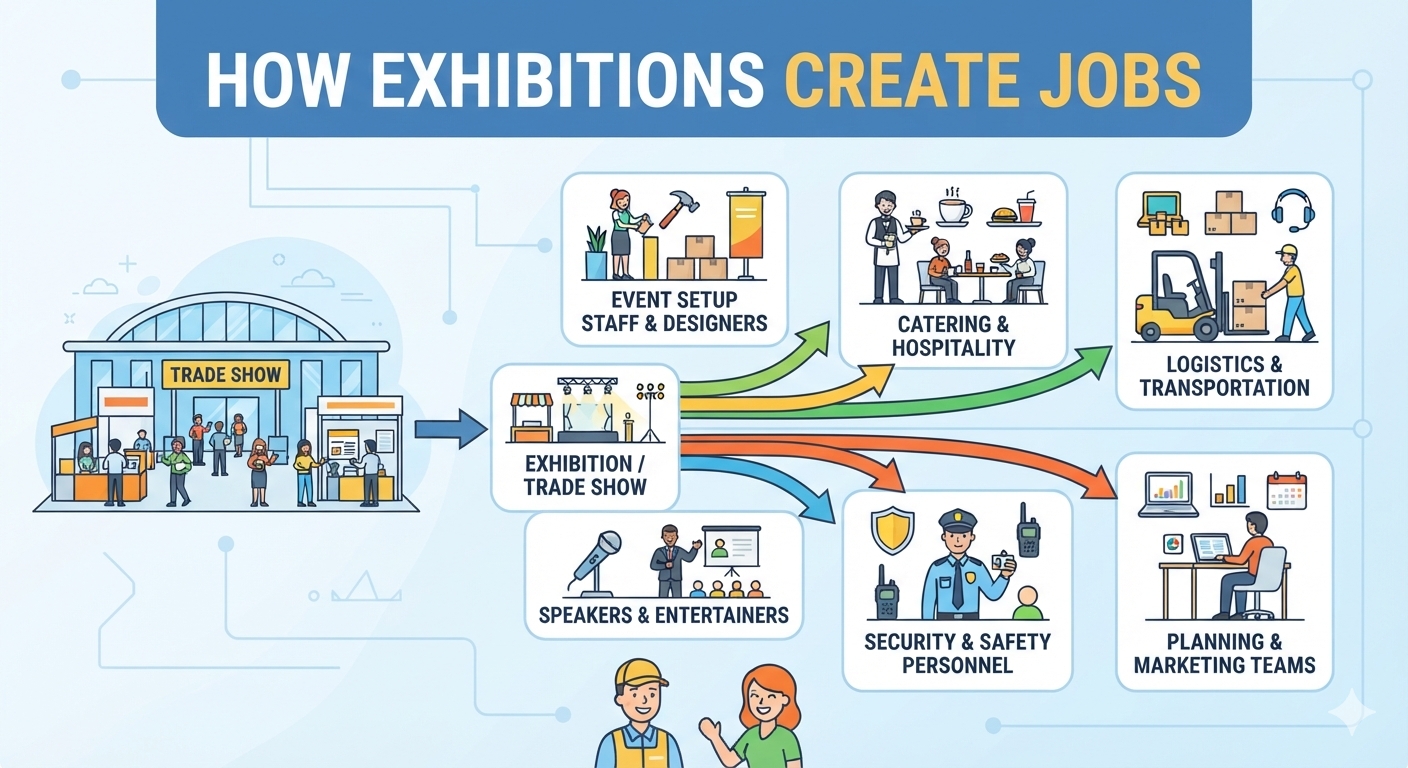
- Stand builders and installers
- Electricians and AV technicians
- Security and first aid teams
- Ushers and registration staff
- Caterers, cleaners and drivers
- Hotel and restaurant teams
After the last visitor leaves
- Dismantling and cargo crews
- Waste and logistics handlers
- Photographers and content producers
- Data, reporting and follow-up teams
Figure 2. Examples of roles across the life of an exhibition. The list is illustrative, not exhaustive.
Notice how varied the roles are. A single exhibition needs engineers and designers, drivers and accountants, cooks and photographers. Many of these are project contracts rather than permanent posts, so it helps to remember that job counts in economic studies are estimates, often expressed as full-time equivalents.
What the studies show
Two published examples show how far the ripple can travel.
About 4.3 million
The equivalent of about 4.3 million full-time jobs supported worldwide by exhibitions in 2024, once direct, indirect and induced effects are added together. Source: UFI and Oxford Economics.
55,000 to 114,000
In UFI's study of UK exhibitions for 2018, more than 55,000 jobs were direct, and the total rose to 114,000 once indirect and induced jobs were counted, roughly double.
These figures come from economic models, so they are estimates, and the UK result is a single example rather than a rule. How far the ripple travels in any country depends on how much of the spending stays in the local economy.
Why local sourcing widens the ripple
Economists use the word leakage for spending that leaves the local economy. When stands are built by local carpenters, banners are printed nearby and lunch comes from local caterers and farmers, more of every shilling becomes local wages, and those wages are spent again close to home. When materials, equipment and crews are all brought in from elsewhere, much of the employment is created elsewhere too.
Kenya's business events sector already has real scale. The Star reported in September 2025, citing industry data, that Kenya hosted more than 3,000 business events in 2023, worth about Sh11 billion in direct MICE-related revenue, with Nairobi taking around 80 per cent of them.
An exhibition is a temporary event, but the work it creates is spread across a lasting web of businesses and households.
Widening the ripple
Organizers and exhibitors can help more of the value stay close to home.
- Source stands, printing, catering and transport from local suppliers where quality and price allow.
- Brief suppliers early, so that short project work becomes more predictable work.
- Invest in event skills, from technical crews to front-of-house teams, so local workers can step into better-paid roles.
Every exhibition tells two stories: the business deals made inside the hall, and the livelihoods supported around it. Both are worth counting.
Planning to exhibit, sponsor or partner on an event?
Exhibition & Events Organizers Ltd. would be glad to talk through what you have in mind.
Exhibition & Events Organizers Ltd. (EEO), Karen, Nairobi, Kenya
Sources: UFI and Oxford Economics, Global Economic Impact of Exhibitions (2024 data, released May 2025), and UFI's economic impact study of UK exhibitions (2018 data, published December 2019), both available via the UFI economic impact studies page; The Star, 11 September 2025. Figures are estimates from the sources named and may be revised in later editions.